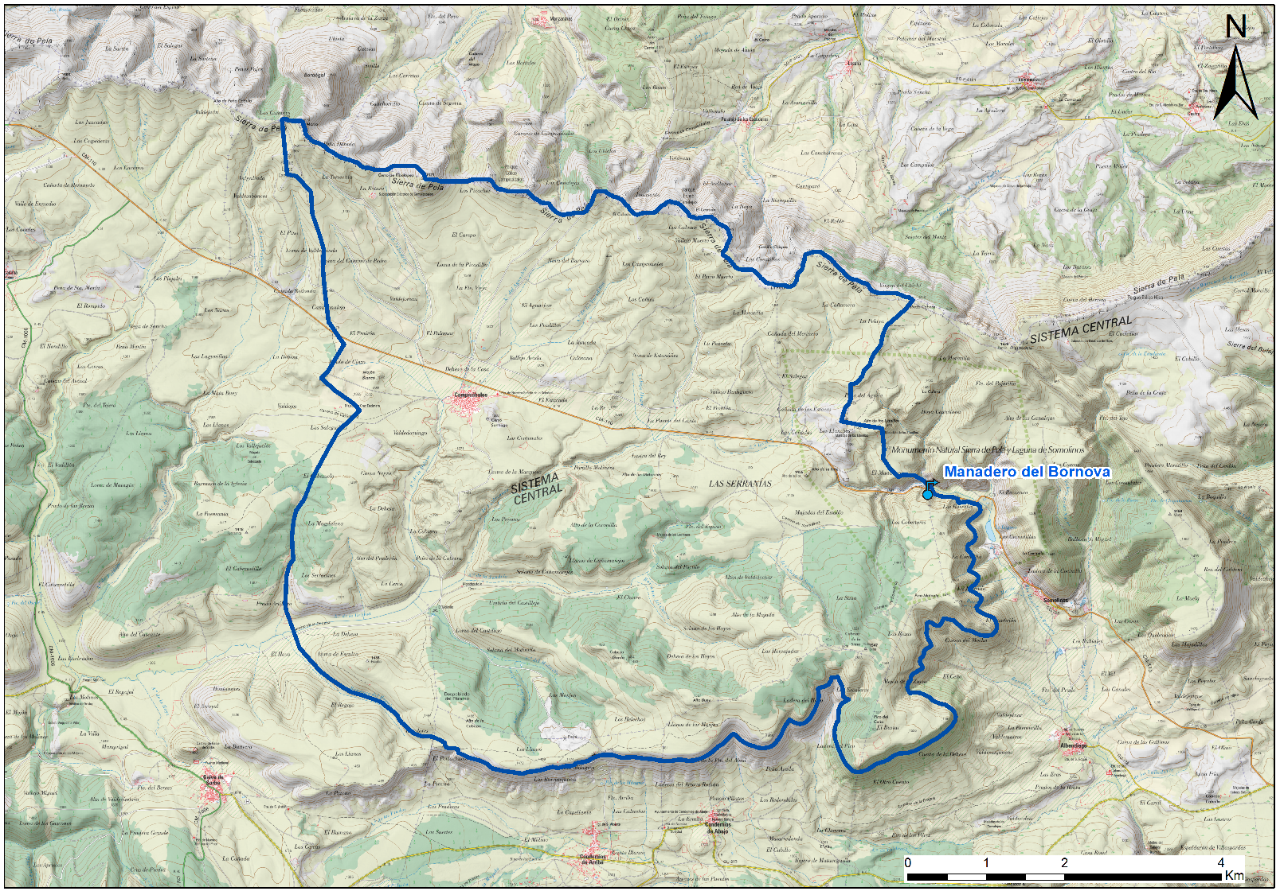
La reserva natural subterránea (RNS) Manadero del Bornova consta de una superficie de 52 km2 y está ubicada en la Sierra de Pela, entre el Sistema Central y el Sistema Ibérico, en la provincia de Guadalajara. Esta reserva se localiza dentro de los límites a la masa de agua subterránea ES030MSBT030.001 Cabecera del Bornova en la Demarcación Hidrográfica del Tajo.
El acuífero que constituye la RNS está formado por calizas y dolomías del Cretácico superior, y es un claro ejemplo de acuífero kárstico. El límite inferior o muro del acuífero está formado por margas y areniscas de la misma edad geológica, que funcionan como materiales impermeables.
La recarga del acuífero se produce principalmente a través de la infiltración directa del agua de lluvia. La superficie de la RNS está surcada por una serie de simas y sumideros que suponen vías de infiltración preferencial, como la Sima de Campisábalos, la Sima de la Cuesta de la Cabrera o la Sima de la Dehesa de los Hoyos. La descarga se realiza a través del manantial Manadero del Bornova, que da nombre a la RNS, con un caudal promedio de unos 150 l/s y ubicado a una cota de 1.298 m.s.n.m. Además de este manantial, hay una serie de surgencias de menor entidad por las que también se produce la descarga de agua de este acuífero, como son la Fuente de las Canalejas, el Molinillo y el Manadero del Sorbe. Estos manantiales aportan en su conjunto un caudal medio de 50 l/s.
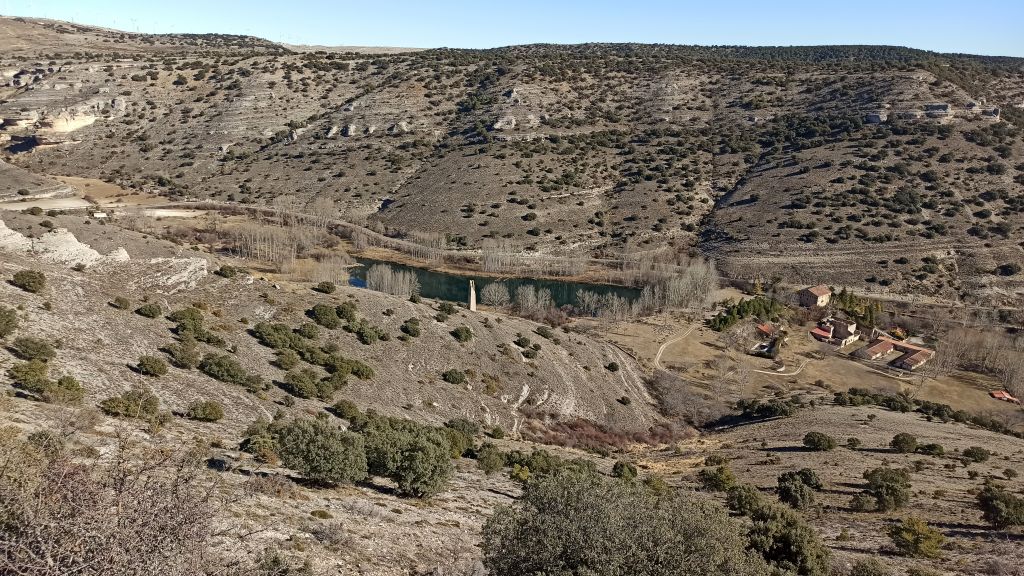
Aguas abajo del Manadero del Bornova se encuentra la laguna kárstica de Somolinos, asociada a terrazas travertínicas del propio río, que conforma un sistema lacustre frágil y singular por su génesis, siendo muy poco frecuente en Europa. Las aguas subterráneas de la RNS Manadero del Bornova sustentan la supervivencia de algunas de las especies de fauna y flora que se pueden observar en el Monumento Natural de la Sierra de Pela y Laguna de Somolinos.
Laguna de Somolinos
Laguna de Somolinos y entorno desde la parte alta del páramo
Manantial Manadero del Bornova
Sima de Campisábalos
This page provides information on cookies we use: We use our own and third-party cookies to keep your session active, personalise your experience, and collect anonymous statistics about how you use this website. You can choose to accept all cookies or select which types you'd like to allow. To learn more about the cookies we use, read our Cookies Policy.
We use two types of cookies on this site. First, there are Functional Cookies, which are essential for the website to work properly. They store session data to make your experience smoother and more convenient. On the other hand, Analytical Cookies collect information about how you use the portal, without personal data, helping us provide a better and more tailored service.
Cookies are small files that are stored on your device when you visit a webpage. They are essential tools that help provide many of the services available on the information society. Among other things, cookies allow a webpage to store and retrieve information about a user's browsing habits or their device. Based on this information, they can be used to recognise the user and enhance the service provided.
Depending on the entity that manages the domain from which the cookies are sent and processes the data, there are two types of cookies: first-party cookies and third-party cookies.
There is also a second classification based on how long the cookies remain stored in the user's browser: session cookies and persistent cookies.
Finally, cookies can also be classified into five types based on the purpose for which the data is processed: technical cookies, personalisation cookies, analytics cookies, advertising cookies, and behavioural advertising cookies.
For more information on this, you can refer to the Guide on the use of cookies from the Spanish Data Protection Agency.
The web portal of the Ministry for Ecological Transition and the Demographic Challenge uses Adobe Analytics, an analytics tool that helps website and application owners understand how visitors interact with their content. Adobe Analytics uses a small number of cookies to collect data and generate usage statistics for websites. This information is sent anonymously and is not shared with third parties under any circumstances. You can choose to accept or reject these cookies, as they do not affect the portal’s functionality. However, they help provide valuable information that allows us to offer a better and more tailored service. For more information about Adobe Analytics cookies and privacy, please refer to the following links:
Additionally, pages featuring content from social network X will only set cookies if the user is logged into the X site. For more details on these cookies, please refer to the following link: Privacy on Social Network X
Finally, a technical cookie named MITECO-compliance is stored, which is a first-party, technical, and session-based cookie. It manages user consent for the use of cookies on the website, remembering which users have accepted them and which have not, ensuring that those who have accepted are not shown cookie consent messages at the top of the page. This cookie is essential for the proper functioning of the portal.
The Ministry for Ecological Transition and the Demographic Challenge gives you the option to accept or reject cookies that are not essential for the portal's operation. Upon accessing the portal, a message will be displayed in the centre of the page with information about the cookie policy and the following options:
· Firefox
· Chrome
· Safari